
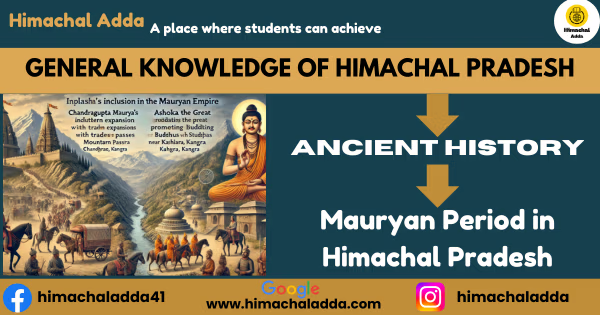
Mauryan Period in Himachal Pradesh
The Mauryan Empire (321 BCE–185 BCE), founded by Chandragupta Maurya, was one of the largest and most centralized empires in Indian history. It marked a significant phase in the history of Himachal Pradesh, as the region became partially integrated into the vast administrative network of the Mauryan state. However, owing to the region’s mountainous terrain and scattered tribal communities, Mauryan influence in Himachal Pradesh was somewhat limited compared to the plains of India.

- Geographical Context of Himachal Pradesh During Mauryan Rule
Himachal Pradesh, located in the Himalayan ranges, had fertile river valleys like those of the Satluj, Beas, and Ravi, making it attractive for agriculture and trade. Its rugged terrain and forests, however, made direct Mauryan control challenging in certain areas, leaving a significant portion under tribal or local rulers.
Important areas potentially influenced by the Mauryan administration:
- Kangra Valley: Known as Trigarta during ancient times, a key trade and agricultural hub.
- Kullu Valley and Chamba: Remote regions that likely maintained semi-autonomous governance under tribal chiefs.
- Spiti and Kinnaur: Difficult terrain with limited accessibility, likely operating under local rulers.
- Inclusion of Himachal Pradesh in the Mauryan Empire
The Mauryan expansion under Chandragupta Maurya, and later Ashoka the Great, brought several regions under centralized governance. The Arthashastra, written by Kautilya (Chanakya), provides insights into Mauryan administrative practices that likely applied to Himachal Pradesh as well.

a. Chandragupta Maurya’s Rule (321–297 BCE):
- Himachal Pradesh became part of Chandragupta’s empire during his northern expansion after defeating the Nanda dynasty.
- His alliance with the Seleucid Empire allowed further stabilization of the region, enhancing trade routes passing through Himachal Pradesh to Central Asia.
b. Ashoka the Great (268–232 BCE):
- Under Ashoka, the Mauryan Empire reached its zenith. His inscriptions suggest a significant interest in propagating Buddhism in this region.
- The Edicts of Ashoka mention the administration of remote provinces and regions in northern India, potentially including parts of Himachal Pradesh.
- Evidence from Kanhiara village (near Kangra) reveals the presence of Ashokan stupas, suggesting Buddhist influence.
- Administrative Setup During the Mauryan Period
The administration in Himachal Pradesh during the Mauryan era mirrored the central governance system but with adaptations for local conditions.
a. Provincial Administration:
- The Mauryan Empire was divided into provinces, each governed by a Kumara (royal prince) or Mahamatya (governor). Himachal Pradesh was likely part of the northwestern province, with Taxila or a nearby location serving as the administrative hub.
- The provinces were further divided into smaller administrative units like districts and villages.
b. Local Governance:
- Tribal chiefs (or Ranas) and local rulers were likely retained as subordinate authorities under the Mauryan administration, especially in regions like Kinnaur, Spiti, and the remote hills of Kullu.
- Local governance might have included tribute payments to Mauryan officials in the form of agricultural produce, livestock, or labor
c. Military Presence:
- To ensure stability and suppress rebellion, Mauryan military outposts may have been established in key areas such as Kangra or Bilaspur.
- The Mauryan army played a critical role in securing trade routes passing through the region.
d. Revenue and Taxation:
- The economic system revolved around taxation, as outlined in the Arthashastra. Taxes were imposed on agriculture, trade, forest resources, and labor.
- Tribes in remote regions possibly paid tribute in lieu of standard taxes.
- Economic and Cultural Impact of Mauryan Rule
The Mauryan period introduced significant changes to the economy and culture of Himachal Pradesh.
a. Economic Developments:
- Trade Routes: Himachal Pradesh’s location on ancient trade routes linking India to Tibet, Central Asia, and the Silk Road was strategically utilized. The Satluj valley served as a critical corridor.
- Agriculture: Mauryan policies encouraged settled agriculture in fertile valleys such as Kangra and Mandi.
- Forestry and Minerals: Himachal’s forests and mineral resources, including possible deposits of copper and silver, were exploited.
b. Cultural Influence:
Buddhism: Ashoka’s efforts to spread Buddhism had a significant cultural impact in Himachal Pradesh.
- Buddhist stupas and rock carvings near Kangra suggest that the region became an important center for Buddhist learning and pilgrimage.
- Traders and monks traveling through Himachal contributed to the spread of Buddhism.
Hinduism and Nature Worship: Despite the growth of Buddhism, local tribes continued worshipping nature deities, mountains, and rivers, which were later integrated into mainstream Hinduism.
- Decline of Mauryan Authority in Himachal Pradesh
The decline of the Mauryan Empire after the death of Ashoka in 232 BCE weakened its hold over distant and difficult-to-administer regions like Himachal Pradesh. Several factors contributed to the reduction of Mauryan influence:
- Internal Fragmentation: The disintegration of the empire into smaller kingdoms led to the emergence of local rulers and the reassertion of tribal power.
- Geographical Challenges: The rugged terrain of Himachal Pradesh always posed a challenge to centralized control.
- Rise of Regional Powers: The successors of the Mauryans, such as the Shungas and Kushanas, had limited reach in Himachal Pradesh, allowing local kingdoms like Trigarta to flourish independently.
- Legacy of Mauryan Rule in Himachal Pradesh
- Despite the relatively short period of Mauryan dominance, their rule left a lasting legacy:
- Spread of Buddhism: The Buddhist influence introduced during Ashoka’s reign endured for centuries, with stupas and monasteries established in the region.
- Trade Networks: The integration of Himachal Pradesh into trade routes promoted regional prosperity and interaction with other parts of the Mauryan Empire.
- Administrative Practices: Mauryan principles of governance, such as tax collection and resource management, influenced the administrative framework of local kingdoms.
Disclaimer: The content in this article has been gathered from various internet sources and books. Himachal Adda is not responsible for any errors or inaccuracies that may occur. For reporting errors or discrepancies, please contact us via email at admin@himachaladda.com or himachaladda41@gmail.com.


