
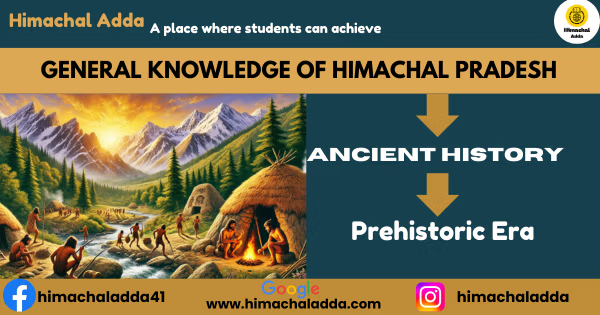
Prehistoric Era of Himachal Pradesh
The administrative and political history of prehistoric Himachal Pradesh is quite complex, as it predates recorded history and is largely based on archaeological findings, oral traditions, and the study of ancient cultures.
Himachal Pradesh, located in the northern part of India, is characterized by its mountainous terrain, including the Himalayas. The region’s geography played a significant role in shaping its prehistoric societies, influencing their settlement patterns, subsistence strategies, and interactions with neighbouring areas.

- Early Human Inhabitants:
Evidence of human habitation in Himachal Pradesh dates back to the Paleolithic era, around 40,000 years ago. Archaeological sites such as the one at *Brahmputra Valley* and *Sanghol* reveal the presence of early humans who were primarily hunter-gatherers

These early communities likely lived in caves and used stone tools, which have been found in various archaeological excavations.
River valleys such as the Satluj, Beas, and Ravi supported early human habitation.
The Pleistocene Period marked the arrival of early humans in the region. Primitive tools and fossils have been discovered, suggesting human life during the Stone Age.
- Archaeological Discoveries
The prehistoric settlements in Himachal Pradesh are divided into the following ages:
a) Paleolithic Era (Old Stone Age): 2.5 million to 10,000 BCE.
Evidence:
- Stone tools and hand axes found in Kangra, Mandi, and Bilaspur regions.
- These tools suggest that early humans were primarily hunters and gatherers, relying on natural resources for survival.
- Early inhabitants preferred riverbanks for water and food sources
b) Mesolithic Era (Middle Stone Age): 10,000 BCE to 8,000 BCE.
Evidence:
- Smaller tools, such as microliths, have been discovered in the Markanda Valley (Sirmaur).
- Nomadic tribes likely migrated seasonally, relying on hunting, fishing, and plant gathering.
- Rock shelters from this period have been identified, showcasing a transition in human behavior and mobility.
c) Neolithic Era (New Stone Age): 8,000 BCE to 4,000 BCE.
Evidence:
- Signs of early agricultural practices and domestication of animals in lower Himachal regions.
- Rudimentary settlements in river valleys such as Spiti, Kinnaur, and Chamba.
- The Neolithic period marks the beginning of social organization and division of labor, which eventually formed the basis of administrative systems.
- Early Administrative Structures
While prehistoric Himachal Pradesh did not have structured political systems akin to later periods, there were basic forms of societal organization:
a ) Clans and Tribal Society:
- Communities were based on kinship ties and survival strategies.
- Elders or chiefs acted as leaders to mediate disputes, allocate resources, and maintain group cohesion.
b) Territorial Unity: Human settlements were confined to valleys, where tribes may have marked their hunting and living territories.
c) Resource Sharing: Primitive communal systems ensured collective use of water, forests, and game for survival.
- Role in the Indus Valley Civilization
During the later prehistoric period, parts of Himachal Pradesh (especially the foothills) witnessed cultural exchanges with the Indus Valley Civilization (2500–1900 BCE).
- Evidence of trade links with the Sutlej and Yamuna rivers as part of the Saraswati river system.
- Artifacts and tools from regions like Sirmaur and Bilaspur show similarities with Indus Valley urban settlements.
- Spiritual Beliefs and Early Culture
The prehistoric inhabitants of Himachal Pradesh had a rudimentary belief system:
- Animism and Nature Worship: Reverence for rivers, mountains, and forests, which laid the foundation for later Hindu practices in the region.
- Totems and Tribal Deities: Tribes may have worshiped their ancestors, totem, animals, and natural phenomena.
- Artistic expressions through rock carvings and primitive pottery have been uncovered, suggesting early cultural development.
- Transition to the Proto-Historic Era
As tribal societies advanced, their rudimentary administration slowly evolved toward more structured systems:
- Introduction of hierarchical leadership based on resource control.
- Inter-tribal relations likely involved conflicts and alliances to secure fertile lands and resources.
- By the proto-historic era, these tribes transitioned to established Janapadas (small kingdoms) as referenced in early Vedic texts.


