Explain TCP/IP Suite
TCP/IP, is a set of communication protocols that govern how data is transmitted, routed, and received over the Internet and many other computer networks. It is the foundation of the modern internet and plays a crucial role in ensuring data communication between devices across the globe.
The main work of TCP/IP is to transfer the data of a computer from one device to another. The main condition of this process is to make data reliable and accurate so that the receiver will receive the same information which is sent by the sender. To ensure that, each message reaches its final destination accurately, the TCP/IP model divides its data into packets and combines them at the other end, which helps in maintaining the accuracy of the data while transferring from one end to another end. TCP/IP stands for Transmission Control Protocol/Internet Protocol, which are two of the most common protocols in the suite.
Internet Protocol :– IP is responsible for addressing and routing packets of data so that they can travel across networks and arrive at their intended destinations. For Example: Imagine we’re sending an email from our computer to a friend’s computer in another country. The IP protocol ensures that the email is broken into packets, each with source and destination IP addresses. These packets are routed through various routers and networks until they reach our friend’s computer.
Transmission Control Protocol (TCP): TCP provides reliable, connection-oriented communication between devices. It establishes and manages a connection, ensures data integrity, and orders packets at the destination.
For Example: When we browse a website, TCP ensures that the web server and our computer/device establish a connection. It also ensures that the web page data is delivered accurately and in the correct order. If a packet gets lost during transmission, TCP requests retransmission to ensure that all data arrives intact.
TCP/IP reference model
TCP/IP consists of four layers: Application, Transport, Internet, and Network Access layer. Each layer has a specific function and uses different protocols to perform it.
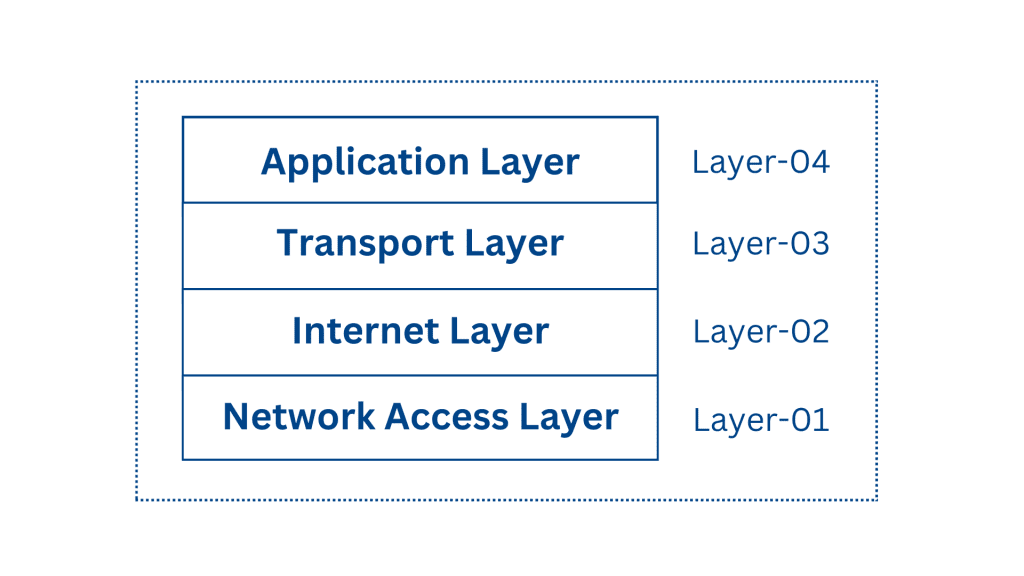
1) Network Access Layer -: it is the first layer of the four layer TCP/IP model. This layer provides access to the physical network media, such as Ethernet cables, wireless signals, optical fibers, etc. Some protocols in this layer are Ethernet, Wi-Fi, Bluetooth, etc.
2) Internet Layer :– it is the second layer of the four layer TCP/IP Model. The position of Internet layer is between Network Access Layer and Transport Layer. This layer provides routing and addressing of data packets across networks, such as assigning IP addresses, forwarding packets, resolving host names, etc. The primary protocol at this layer is the Internet Protocol (IP). IPv4 and IPv6 are versions of the IP protocol.
3) Transport Layer-: it is the third layer of four layer of TCP/IP. This layer provides reliable and efficient data transfer between devices, such as error detection, flow control, congestion control, etc. The most common transport layer protocols are Transmission Control Protocol (TCP) and User Datagram Protocol (UDP).
4) Application Layer :- it is the top most layer of four layer TCP/IP model. This layer provides services for applications to exchange data, such as email, web browsing, file transfer, etc. A wide range of protocols and services operate at this layer, including HTTP (for web browsing), SMTP (for email), FTP (for file transfer), and many others.