
History of Banking System in India
Before we start we need to understand where the term “Banking” emerged. The term Banking emerged from an Italian word “ Bancho ” which mean is “bench”. In early days people used to do transactions sitting on a bench since then this banking term came into the picture.
Italy is known for the origin of the World Banking System. The first-ever bank was also established in Italy in 1157 which name was Bank of Venice.The second bank was Bank of Barcelona established in 1401,The third bank was Bank of Geneva in 1407 and The fourth bank was Bank of England established in 1694. So we knew some clues of the history of world banking. Now we must know what is the meaning of banking or general definition of banks.
Definition of bank-:
As per banking regulation act 1949 under section 5(B) definition of bank is: “A financial institution which can accept deposit of money from the public, lend to the public and repayable to the public on demand and withdrawal by cheque, draft, order”.
Banking Regulation Act 1949, Section 5 does Interpretation of “Bank”. This Act defines the “Bank” and “Banking Company”.
“Banking Company” means a company which transacts the business of banking.
What is Banking Regulation Act 1949?
Banking Regulation Act, 1949 is legislation in India that regulates all banking institutions comes under RBI. Initially, the law was applicable only to banking companies. But, in 1965 it was amended to make it applicable to cooperative banks and to introduce other changes.
In simple words “ Banks are the financial institutions which accepts deposits of funds from public and provide withdrawal whenever demanded by depositors. Banks also provide some other facilities like advance, credit, different types of loans to their customers ”
History of Banking System in India
During ancient times, businessmen were called shroffs, seths, sahukars, mahajans, chettis etc. and they carry the business of banking at that time. In the year 1770, the first bank of India was formed and named as Bank of Hindustan, in Calcutta and managed by Europeans.
So it was not truly ‘Swadeshi’ and stop operating after 1832. After the bank of Hindustan, various banks were set up.
The Banking sector in India has seen a lot of transitions and changes over the centuries. The Banking system in India can be categorised in two phases.
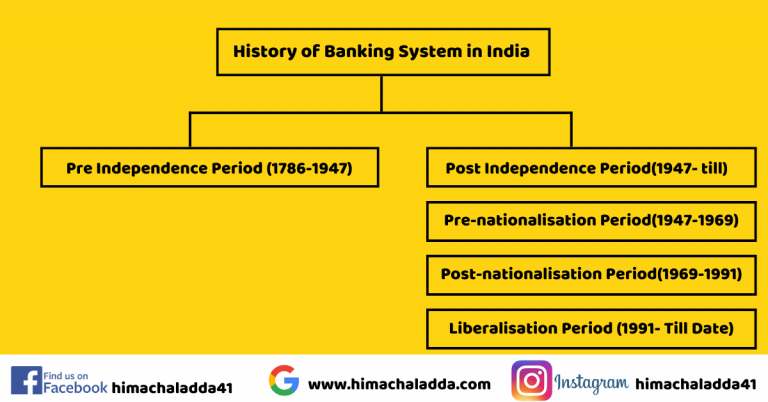
- Pre-Independence Phase (1786-1947)
- Post- Independence Phase (1947 to till date)
The post-Independence period may further be divided into three phases-
- Pre-nationalisation Period (1947 to 1969)
- Post nationalisation Period (1969 to 1991)
- Liberalisation Period (1991 to till date)
1) Pre-Independence Phase (1786-1947)
As per history of banking in India,banking system was introduced by Europeans. Alexander and company was the first European company who introduced banking system in India.
In history of banking in India, first bank was “Bank of Hindostan”. Bank of Hindostan was established in year 1770 in calcutta by “Alexander and Company” which was European company. Bank of Hindostan served the banking services to the people for 62 years only.
The main focus of Alexander and Company was to facilitate East India Co.In year 1832 Bank of Hindostan shut its operation and banking services due to banking crisis.
In Indian banking history,”The Bengal Bank” was founded on 1 April 1784. The bank was the fourth oldest bank in India.The bank became defunct on March 31st, 1791.
“The Bengal bank” introduced cheque book in banking system. Introduction of cheque book was the revolutionary step in history of banking system in India.
During the Pre Independence period over 600 banks had been registered in the country, but only a few managed to survive.
Following the path of Bank of Hindustan, various other banks were established in India. They were:
- The General Bank of India (1786-1791)
- Bank of Bengal (1809) – It was set up as the bank of Calcutta on 2 June 1806 and renamed the bank of Bengal in 1809
- Bank of Bombay (1840)
- Bank of Madras (1843)
Bank of Bengal, Bank of Bombay and Bank of Madras are called the Presidential Banks. These three banks were later merged into one single bank in 1921, which was called the “Imperial Bank of India.”
The Imperial Bank of India was later nationalised in 1955 and was named The State Bank of India, which is currently the largest Public sector Bank.
Some Important Banks During The Pre-independence Time:
- Oudh commercial bank (1881-1958)– It was the first bank managed by Indian boards with limited liabilities. It was set up in Faizabad in 1881 and stopped operating in 1958.
- Allahabad Bank (1865)– It was owned by Europeans.
- Punjab National Bank (1894)– It was the first bank that was completely owned by Indians. This bank was set up in Lahore in 1895. It is not only survived till now but also is one of the largest bank in India. Lala Lajpat Rai play the main role in the foundation of PNB.
- Bank of Baroda (1908)– It was set up by Maharaja Sayajirao Gaekwad III.
- Central Bank of India was set up in 1911, and it was the first Indian commercial bank which was purely owned and managed by Indians. So, it is India’s first truly Swadeshi Bank. The founder of the central bank of India was Sir Sorabji Pochkhanawala and Pherozshah Mehta was its first chairman.
- Union Bank of India was inaugurated by Mahatma Gandhi in 1919.
- From 1913-30s State Bank of Mysore, the State Bank of Patiala was set up and this period had seen the rise and collapse of the banking industry, after the Birth of RBI (1935) took place.
- In the 1940s State bank of Bikaner, Jaipur, Hyderabad, and Travancore were established by the respective princely states and Nawabs. After the Post-Independence period these banks were ‘Associated Banks of SBI’, and ultimately, merged with the State Bank of India (2017).
- First Bank that opened its branch on foreign soil was Bank of India. Its first branch was opened in London in 1946 and was the first to open a branch in continental Europe in Paris in 1974. In September 1906, the bank of India was founded as a private entity and later nationalized in 1969. Its logo is like a star and its headquarter is located at star house, Bandra East, Mumbai.
2) Post Independence Period (1947-1991)
At the time when India got independence, all the major banks of the country were led privately which was a cause of concern as the people belonging to rural areas were still dependent on money lenders for financial assistance.
With an aim to solve this problem, the then Government decided to nationalise the Banks. These banks were nationalised under the Banking Regulation Act, 1949.
Whereas, the Reserve Bank of India was nationalised in 1949.
What is nationalisation?-: Nationalisation is the process in which government takes the control on private companies, industries, or assets. To convert any private sector entity into public sector on issues of public interest is called Nationalisation.
Read More – History of Reserve Bank of India (RBI)
a) Pre-nationalisation Period (1947 to 1969)
After independence, a committee was formed by Government of India named as “The All India Rural Credit Survey Committee, commissioned in August 1951 headed by A.D. Gorwala. Recommendation of Gorwala committee, Government of India and Reserve Bank of India took decision of nationalisation of imperial bank. On provisions of State Bank of India Act 1955, The Government of India took control of the Imperial Bank of India in 1955 with reserve bank of India taking a 60% stake. On 1 July 1955, the Imperial Bank of India was nationalized and renamed as the State Bank of India.
b) Post nationalisation Period (1969 to 1991)
Extensive evolution in banking in India was first time bulk Bank Nationalisation was done on July 19, 1969, 14 major lenders that accounted for 85% of bank deposits in the country at that time were nationalized. For nationalisation, net demand and time liability was 50 crore and above.
Given below is the list of these 14 Banks nationalised in 1969:
- Allahabad Bank
Allahabad Bank was an Indian nationalised bank with its headquarters in Kolkata, India. Founded in Allahabad in 1865 and nationalized by the government of India in 1969, the bank provided banking and financial services for 155 years until it was merged with Indian Bank in 2020.It was the oldest still running joint stock bank in India until it’s merger.) - Bank of India
Bank of India was founded on 7 September 1906 by a group of eminent businessmen from Mumbai, Maharashtra, India. The Bank was under private ownership and control till 19 July 1969 when it was nationalised along with 13 other banks. The Head Office of the Bank of India is situated in Mumbai. - Bank of Baroda
The bank was founded by the Maharaja of Baroda, Maharaja Sayajirao Gaekwad III on 20 July 1908. The bank, along with 13 other major commercial banks of India, was nationalised on 19 July 1969, by the Government of India and has been designated as a profit-making public sector undertaking (PSU). - Bank of Maharashtra
Headquater at pune. - Central Bank of India.
- Canara Bank
- Dena Bank
Dena Bank was a government-owned bank that in 2019 merged with Bank of Baroda. It was headquartered in Mumbai and had 1,874 branches. - Indian Overseas Bank
- Indian Bank
- Punjab National Bank
- Syndicate Bank
At the time of its establishment, the bank was known as Canara Industrial and Banking Syndicate Limited. The bank, along with 13 major commercial banks of India, was nationalised on 19 July 1969, by the government of India.
It was headquartered in the university town of Manipal, India. On 1 April 2020, the bank was merged into Canara Bank. - Union Bank of India
- United Bank
- UCO Bank
Nationalisation of Banks in 1980
Revolutionary evolution of banking in India was second time again bulk Bank Nationalisation was done in year 1980, 6 banks were nationalized. For nationalisation, net demand and time liability was 200 crore and above.
- Andhra Bank
- Corporation Bank
- New Bank of India
- Oriental Bank of Comm.
- Punjab & Sind Bank
- Vijaya Bank.
- On 4 Sept 1993, one bank was merged in Punjab National Bank that was New Bank of India. After merger only 19 banks were left which were nationalized bank.
These banks were nationalized under Banking Company Act 1970 and 1980.
Nationalisation of banks was the historical development of banking institutions in India.
c) Liberalisation Period (1991-Till Date)
In year 1991 for reforms in Indian economy contemporaneous Finance minister Sh. Manmohan singh took a step on a policy of liberalization licensing of small number of private banks. These new banks were known as New Generation tech-savvy banks. Global Trust Bank was the first of such new generation bank, which later amalgamated with Oriental Bank of Commerce.
To provide stability and profitability to the Nationalised Public sector Banks, the Government decided to set up a committee under the leadership of Shri. M Narasimham to manage the various reforms in the Indian banking industry.
The biggest development was the introduction of Private sector banks in India. RBI gave license to 10 Private sector banks to establish themselves in the country. These banks included:
- Global Trust Bank.
- ICICI Bank – The Industrial Credit and Investment Corporation of India (ICICI) was established on 5 January 1955 and Sir Arcot Ramasamy Mudaliar was elected as the first Chairman of ICICI Ltd. It was structured as a joint-venture of the World Bank, India’s public-sector banks and public-sector insurance companies to provide project financing to Indian industry. ICICI Bank was established by ICICI, as a wholly owned subsidiary in 1994 in Vadodara. The bank was founded as the Industrial Credit and Investment Corporation of India Bank, before it changed its name to ICICI Bank. The parent company was later merged with the bank. ICICI Bank launched Internet Banking operations in 1998. In 1999, ICICI become the first Indian company and the first bank or a financial institution from non-Japan Asia to be listed on the NYSE.
- HDFC Bank – The Housing Development Finance Corporation Limited or HDFC was among the first financial institutions in India to receive an “in principle” approval from the Reserve Bank of India (RBI) to set up a bank in the private sector. This was done as part of RBI’s policy for liberalisation of the Indian banking industry in 1994. HDFC Bank was incorporated in 1994 as a subsidiary of the Housing Development Finance Corporation, with its registered office in Mumbai, Maharashtra, India.Its first corporate office and a full-service branch at Sandoz House, Worli were inaugurated by the then Union Finance Minister, Manmohan Singh. It is India’s largest private sector bank by assets and world’s 10th largest bank by market capitalisation as of April 2021. It is the third largest company by market capitalisation of $122.50 billion on the Indian stock exchanges.It is also the fifteenth largest employer in India with nearly 150,000 employees.
- Axis Bank
- Bank of Punjab
- IndusInd Bank –The bank began its operations on 17 April 1994 under the chairmanship of P. Hinduja with the primary objective of serving the NRI community. IndusInd Bank Limited is a new-generation. Indian bank headquartered in Mumbai(Maharashtra). The bank offers commercial, transactional and electronic banking products and services. IndusInd Bank was inaugurated in April 1994 by then Union Finance Minister Manmohan Singh. IndusInd Bank is the first among the new-generation private banks in India.
- Centurion Bank.
- IDBI Bank –The IDBI Bank Limited (IDBI Bank or IDBI) is a subsidiary of Life Insurance Corporation (LIC) providing financial and banking services. It was established in 1964 as Industrial Development Bank of India, a development finance institution, which provided financial services to industrial sector.In 2005, the institution was merged with its commercial division, IDBI Bank, forming the present-day banking entity and was categorised as “other public sector banks” category.Later in March 2019, RBI recategorised it as a private bank. Many national institutes find their roots in IDBI like SIDBI, India Exim Bank, National Stock Exchange of India and National Securities Depository Limited.
- Times Bank.
- Development Credit Bank
The other measures taken include:
- Setting up of branches of the various Foreign Banks in India
- No more nationalisation of Banks could be done
- The committee announced that RBI and Government would treat both public and private sector banks equally
- Any Foreign Bank could start joint ventures with Indian Banks
- Payments banks were introduced with the development in the field of banking and technology
- Small Finance Banks were allowed to set their branches across India
- A major part of Indian banking moved online with internet banking and apps available for fund transfer
Thus, the history of banking in India shows that with time and the needs of people, major developments have been brought about in the banking sector with an aim to prosper it.
History of Banking System in India : Some Important facts
- In 1996, Canara Bank became the first Indian Bank to get ISO certification for “Total Branch Banking” for its Seshadripuram branch in Bangalore.
- Bank of India was the first Indian bank to open overseas branch. Bank of India established a branch in London in year 1946.
- Central Bank of India was the first bank who launched the first bank credit card in year 1980, which was followed by Andhra Bank in year 1981.
- In year 1860, the Comptoir d’Escompte de Paris opened a branch in Calcutta. This was the first foreign bank in India.
- Industrial Credit and Investment Corporation of India (ICICI) was the first Indian bank who introduced Internet-Banking (in year 1996) and Mobile ATM facilities to Indian banking system first time.
- The first ATM in India was set up in 1987 by HSBC in Mumbai.
- In 2012, Union Bank of India unveiled India’s first accessible and Talking ATM in Vastrapur, Ahmedabad, Gujarat on 6 June 2012 for the visually and physically challenged people.


Pingback: Formation of State Bank of India (SBI) | Himachal Adda